About RECEBA
RECEBA is a European Centre of Vocational Excellence on circular economy skills, co-funded by the Erasmus+ programme. It brings together everyone the circular transition depends on: companies with real challenges, education providers with training to adapt, learners building careers, regional authorities setting priorities, and researchers supplying the evidence. Together they turn skills needs into training, recognised credentials, and working business solutions.

The gap between circular ambition and daily practice
Across Europe, most companies recognise the value of the circular economy. Far fewer manage to make it work in daily operations, because circular practice rarely fits a single job description: whether a firm is rethinking its product range, its supply chain, its waste streams, or its entire business model, each move demands technical, commercial, digital, and regulatory competences working together. Most businesses, especially SMEs, lack the skills mix and the implementation know-how to turn circular ambition into profitable operations.
For workers and learners, the transition is reshaping jobs faster than training can follow. From manufacturing and construction to resource management and digital services, new roles and task profiles keep emerging, and companies struggle to fill them. Yet the skills these roles require are rarely defined, rarely taught, and even when acquired, hard to prove: there are few credentials an employer can read and trust.
Education and training systems face the mirror problem. Technical programmes cover recycling and resource efficiency but leave out business model innovation; business courses teach management but exclude the technical side. Neither produces the hybrid profiles the circular economy runs on, and curricula organised by traditional sector boundaries struggle to keep pace with needs that cut across them.
Regional authorities feel the gap from yet another angle. Circular economy ranks high in regional innovation strategies across Europe, but turning strategy into operational business practice has proven slow, partly because regions lack solid evidence on which skills their economies actually demand. Without it, training offers and business support tools are adjusted by intuition rather than data.
How RECEBA works
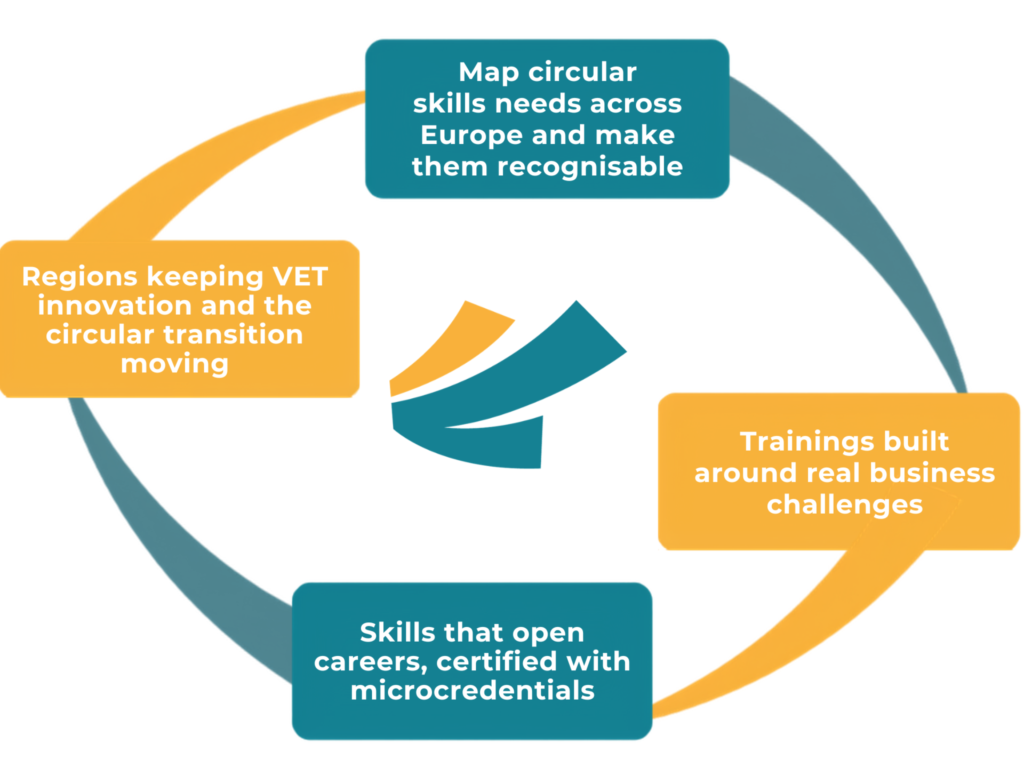
Map circular skills needs
RECEBA maps circular economy skills needs directly with companies, through surveys, interviews, and regional expert panels, building the evidence base that regional strategies and training offers currently lack. The work feeds a shared European vocabulary of circular skills, so that a competence identified in one region is recognisable in all the others.
Design and deliver trainings
The findings become trainings co-designed with the businesses that will use it, covering the core domains of circular practice, from business models and materials to digital traceability and compliance. Teaching follows the challenge-based approach: learners work on real company problems, with VET teachers, trainers, and industry mentors trained by the project to guide them.
Certify with microcredentials
The findings become trainings co-designed with the businesses that will use it, covering the core domains of circular practice, from business models and materials to digital traceability and compliance. Teaching follows the challenge-based approach: learners work on real company problems, with VET teachers, trainers, and industry mentors trained by the project to guide them.
Anchor labs in the regions
Circular Business Labs are built to remain: regional structures where companies keep bringing challenges and learners keep solving them after the project ends. Regional VET Excellence Panels anchor them to local priorities and feed what the labs learn back into regional policy, while a European Community of Practice carries the knowledge between regions.
Partners
The RECEBA partnership brings together organisations from Italy, Belgium, Bulgaria, the Netherlands, Spain, and France, supported by associated and supporting organisations across Europe. Each partner contributes specific expertise in VET, circular economy, business support, innovation, regional policy, research, and digital learning.