



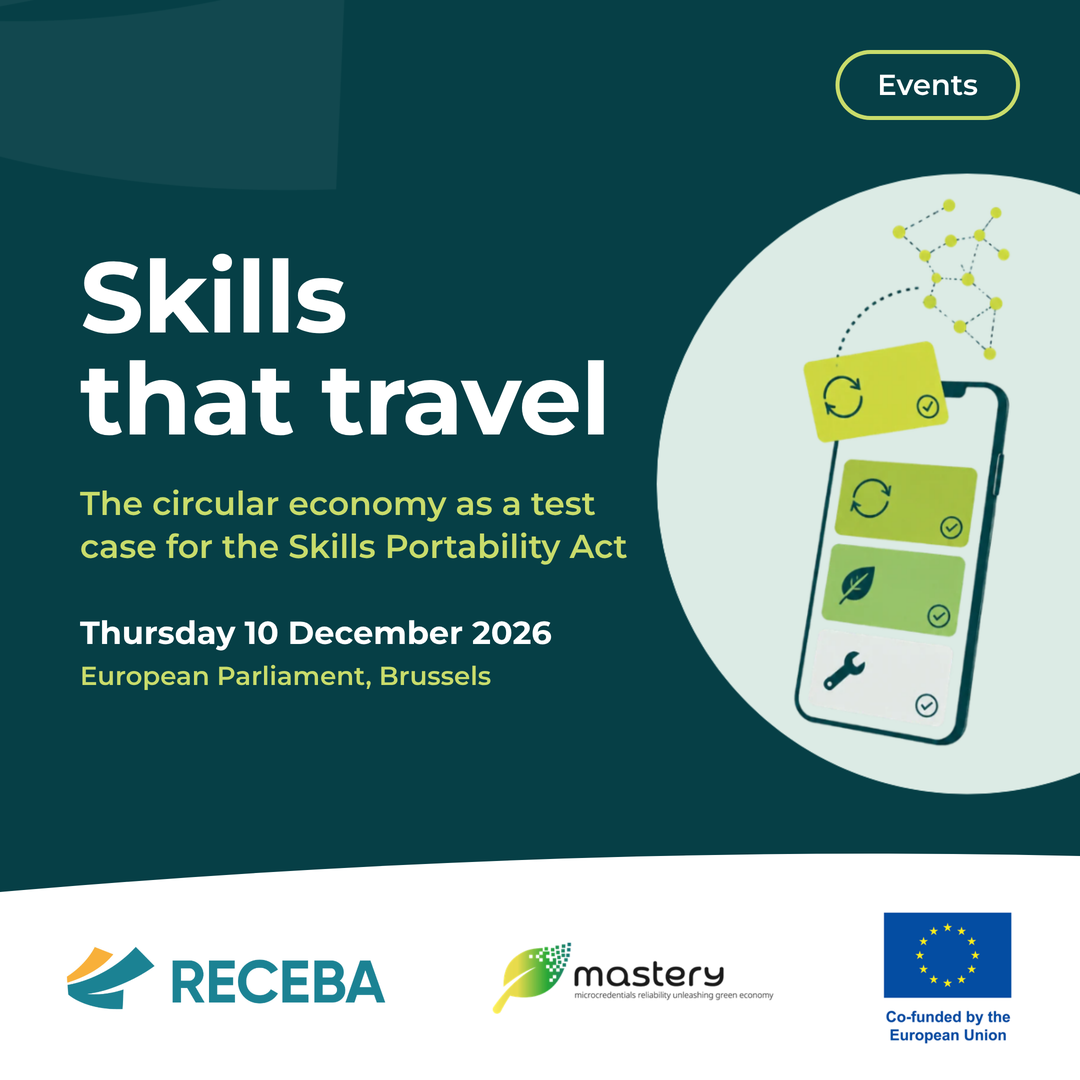
The Skills Portability Act, proposed by the European Commission on 15 September, is now with the European Parliament and the Council. On Thursday 10 December 2026 the workshop “Skills that travel” brings the discussion to the Parliament in Brussels, with the circular economy as its test case. It is held with two cross-party groups of Members of the European Parliament (MEPs), the Intergroup on the Future of Education and Skills for a Competitive Europe and the MEP Group on Climate Change, Biodiversity and Sustainable Development.
The Act belongs to the Fair Labour Mobility package and sets a standard digital format for qualifications in the European Digital Identity Wallet, so that a qualification obtained in one Member State can be read, checked and trusted in another. It is one of three steps in European skills policy this autumn. On 21 October the Parliament adopted its resolution on vocational education and training in times of transition by 504 votes to 63, with 99 abstentions, and on 5 November the Commission’s new European Strategy for Vocational Education and Training announced short training modules, developed with industry, that could lead to microcredentials.
The workshop looks at these texts from the side of those who design and issue new credentials. Two Erasmus+ projects are behind it: MASTERY, which has tested microcredentials for green skills and the conditions that make them reliable for an employer in another country or sector, and RECEBA, whose microcredentials will be designed with companies in six regions and need to be understood from one region to the next. Other initiatives represented among the speakers, such as the BuildSkills Academy Centre of Vocational Excellence for construction and the TCLF SkillBridge regional skills partnerships for textiles, clothing, leather and footwear, raise the same question: how a credential can be recognised beyond the project that created it.
The morning has two panels: the first asks what it takes for a credential to be trusted across borders and sectors and carried in a digital wallet, and the second looks at how regions and sectors build skills with industry and get them recognised. Speakers come from the European Commission and the European Economic and Social Committee, and from ACR+, Cleantech Bulgaria, Euratex, the Lifelong Learning Platform, Région Normandie, the Schuman Associates Skills Coalition and Sistemi Formativi Confindustria. MEPs from four political groups open, moderate and close the debate.
The workshop runs from 08:00 to 09:40 in the Members’ Salon of the Altiero Spinelli building and takes place in person. Registration is required, at: